
Table of Contents
24/7 Elevator Repair Services Madhapur | Expert Lift Maintenance
Managing vertical transit infrastructure in Madhapur requires an understanding of high-density engineering, microclimate heat stressors, and evolving local regulatory compliance frameworks. As the primary economic engine of Hyderabad’s tech corridor, Madhapur encompasses a highly demanding mix of environments—ranging from premium glass-facade IT parks and busy commercial complexes along the HITEC City road to high-density residential high-rises and luxury villas in Kavuri Hills and Jubilee Hills surroundings.
When an elevator system experiences mechanical failures, electrical faults, or intermittent leveling errors, it stops being a mere building amenity and becomes a major operational liability. For asset managers, residential welfare associations (RWAs), and corporate facility heads, selecting professional elevator repair services in Madhapur is critical to preserving asset lifecycles, ensuring safety, and maintaining strict regional compliance.
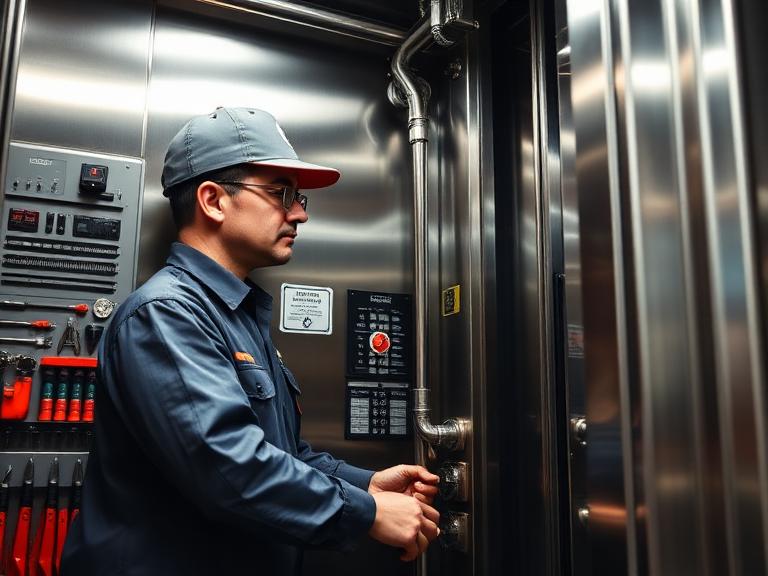
1. The Madhapur Vertical Transit Environment
The commercial and residential density of Madhapur subjects elevator installations to exceptional operational duty cycles. Unlike standard low-rise suburban structures, elevators running in this technical hub encounter specific systemic challenges that accelerate component wear.
High-Frequency Traffic Patterns
In major IT centers and commercial corporate parks across Madhapur, elevators handle continuous, peak-heavy traffic profiles. High-speed passenger lifts operating at velocities from $1.5\text{ m/s}$ to $2.5\text{ m/s}$ run almost continuously during morning check-ins, lunch hours, and evening departures.
This sustained cycling subjects variables like door operator motors, brake pads, and drive profiles to immense mechanical stress. When components start degrading, it often manifests as minor floor-leveling discrepancies or doors failing to open or close on the first attempt, signaling the need for targeted electro-mechanical repairs.
Microclimate and Thermal Stress
Hyderabad’s ambient summer temperatures regularly surpass $40^\circ\text{C}$. In Madhapur’s architectural landscape, lift shafts built along glass curtains or within unconditioned concrete cores experience significant thermal accumulation.
Excessive heat within the overhead machine room or the top of a Machine-Room-Less (MRL) shaft alters the operational characteristics of the system:
- Variable Voltage Variable Frequency (VVVF) Drives: High temperatures stress the internal capacitors and power modules of inverter drives, resulting in intermittent thermal tripping faults.
- Lubricant Degradation: High ambient temperatures lower the viscosity of gear oils and guide rail lubricants, increasing friction across car guide shoes and counterweight assemblies.
- Battery Degradation: Lead-acid and lithium-ion battery banks powering Automatic Rescue Devices (ARDs) degrade prematurely under high ambient temperatures, causing sudden system failures during power disruptions.
Power Quality Variations
Despite Madhapur’s modernized subterranean utility infrastructure, localized voltage fluctuations, transient surges, and switching transitions between utility power and backup diesel generator (DG) sets remain common. These electrical fluctuations stress sensitive electronic control boards, solid-state relays, and safety circuit components, requiring specialized diagnostic troubleshooting and repair.
2. Common Technical Failures in Modern Elevator Systems
To implement efficient diagnostic and remediation strategies, field technicians categorize elevator failures into structural, mechanical, electrical, and regulatory safety domains.
Subsystem A: Intelligent Door Systems and Optical Curtains
Statistically, more than $70\%$ of unexpected elevator service calls originate within the door operator subsystem. Because the doors cycle at every floor stop, they are highly prone to mechanical misalignment and electrical component fatigue.
- Infrared Safety Curtains: Modern commercial elevators utilize multi-beam infrared light screens to detect passengers entering or exiting the cabin. Dust, physical impacts, or structural shifting can misalign these optical sensors, forcing the doors into a continuous nudge mode or halting elevator travel altogether.
- Door Hanger Rollers and Eccentrics: Accumulation of debris within the landing door sills or wear on the polyurethane layer of hanger rollers increases rolling resistance. This causes the door motor to draw excessive current, tripping the door drive’s overcurrent protection loop.
- Interlock Contacts: Landing door interlocks act as critical electromechanical safety links. If copper contacts oxidize or structural settling slightly misaligns the mechanical lock beak, the controller cannot establish the safety loop string, disabling the elevator.
Subsystem B: Traction, Suspension, and Leveling Systems
The physical movement of the elevator car relies on precise friction balances and mechanical positioning.
- Sheave Groove Wear: Over years of operation, the steel hoist ropes wear down the cast-iron grooves of the main traction sheave. This wear can lead to unequal seating depth across ropes, causing rope slippage, uneven ride vibrations, and accelerated rope fatigue.
- Leveling Inaccuracy: If an elevator stops more than $\pm 5\text{ mm}$ away from the flush floor landing level, it presents a significant tripping hazard. This error typically stems from slipping magnetic floor encoders, failing inductive proximity sensors, or improper deceleration curve programming within the VVVF drive.
- Guide Shoe Assembly Failure: Worn sliding guide shoes or damaged roller guides generate lateral car vibration, structural cabin rumbling, and audible scraping noises along the guide rails, which directly compromises passenger comfort.
Subsystem C: Control Electronics and Electrical Safety Loops
The brain of the elevator system—the microprocessor controller—monitors a continuous chain of safety switches connected in a series circuit.
An open circuit anywhere along this string immediately cuts power to the main drive and drops the mechanical brake. Locating an intermittent open circuit requires high-resolution digital multimeters and technicians adept at interpreting complex schematic ladder diagrams.
3. Comprehensive Breakdown of Elevator Repair Workflows
Resolving complex vertical transport faults requires systematic, code-compliant workflows. Industrial elevator repair is an exacting engineering discipline where shortcuts can lead to catastrophic system failures.
Step 1: Computational & Physical Fault Diagnostics
When a technician arrives at a building site in Madhapur, they begin by interfacing with the elevator controller’s diagnostic terminal or using an external handheld tool. Modern microprocessor controllers maintain an internal non-volatile error log that indexes system faults with specific error codes and timestamps.
By referencing these fault records against the manufacturer’s technical manual, the service team can target individual components without performing destructive testing across the entire system.
Step 2: Mechanical Component Re-engineering & Replacement
When structural components like traction sheaves, deflector sheaves, or suspension ropes show signs of wear beyond allowable limits, major mechanical interventions are required.
The process of replacing hoist ropes requires isolating the elevator cabin at the top of the hoistway using heavy-duty rated structural steel clamps and chain hoists. Technicians then remove tension from the counterweight framework, unweave the old steel wire ropes, and install new independent wire rope core (IWRC) assemblies, ensuring equal tension distribution across all lines via calibrated tension meters.
Step 3: Electrical Restoration and Drive Calibration
When a VVVF drive fails or requires replacement, technicians must carry out a detailed motor auto-tune routine. The replacement controller or inverter must map the exact electrical characteristics of the hoist motor, including:
- Stator winding resistance ($R_s$)
- Transient rotor inductance ($L_r$)
- No-load current parameters
Proper calibration ensures smooth acceleration and deceleration curves (S-curve profiling), which minimizes jerk and delivers seamless transitions during floor arrivals.
4. Modernization vs. Spot Repairs: Asset Lifecycle Optimization
Building owners in Madhapur frequently face a tough decision: should they continue investing in spot repairs for an aging elevator, or is it time to authorize a complete system modernization?
The Aging Profile of Vertical Assets
Elevator systems generally have an optimal operational lifecycle of $15$ to $20$ years, assuming routine maintenance. Beyond this window, the frequency of component failure escalates sharply, and souring original equipment manufacturer (OEM) replacement parts becomes difficult due to technology obsolescence (such as the shift from older relay-logic controllers to solid-state CAN-bus distributed architectures).
Key Indicators for Strategic Modernization
Property managers should consider a modernization program if the asset exhibits any of the following operational trends:
- High Frequency of Downtime: The elevator averages more than two unscheduled shutdowns per quarter.
- Longer Wait Times: The system configuration lacks modern destination control software, causing noticeable passenger congestion in commercial building lobbies.
- High Energy Costs: The installation continues to rely on older geared traction machines or energy-inefficient hydraulic drives, missing out on the energy savings of gearless permanent magnet synchronous motor (PMSM) technologies.
The Modernization Engineering Process
Partial or full modernization updates the core components while keeping the structural guide rails and counterweight frameworks intact. Technicians replace the outdated control controller box with an advanced microprocessor panel, swap out the old geared hoisting machine for an energy-efficient gearless PMSM motor, and install modern car operating panels (COP) equipped with liquid crystal displays and smart access controls.
5. Regulatory Landscape & Compliance Standards in Telangana
The regulatory framework for vertical transportation in Hyderabad is undergoing significant transformation, driven by judicial scrutiny and the expansion of high-rise construction. Operating an elevator requires strict adherence to safety standards and legal mandates.
Evolving Statutory Frameworks
Following public interest litigation, the Telangana High Court directed state authorities to expedite updates to comprehensive safety legislation, highlighting the critical importance of regular engineering certifications. Current operations are governed under the provisions of the Telangana Lifts, Escalators, and Passenger Conveyors framework, which mandates clear design, licensing, and testing protocols.
Mandatory Safety Features Checklist
Every elevator operating in Madhapur must incorporate specific safety features to comply with Bureau of Indian Standards (BIS) norms, including IS 14665 (for electric traction lifts) and IS 15785 (for MRL installations):
- Automatic Rescue Device (ARD): An automated emergency backup power system that activates instantly during a utility blackout. It releases the mechanical brake, powers the motor using a dedicated battery bank, and moves the cabin at low speed to the nearest landing floor, safely opening the doors to prevent passenger entrapment.
- Overspeed Governor and Safety Gear: A mechanical safety loop independent of the electrical system. If the elevator car exceeds its rated downward velocity, a calibrated governor flies open, tripping a steel cable rope that activates mechanical safety jaws clamped onto the guide rails, bringing the car to a secure stop.
- Infrared Multi-Light Screen: A non-contact safety system that continuously sweeps the elevator entry path to prevent doors from closing on passengers.
- Phase Reversal and Single-Phasing Preventers: Electrical protective relays that monitor incoming utility power lines. If a phase shifts or drops, the relay isolates the control controller to prevent the hoist motor from turning backward or overheating.
6. Proactive Protection: Annual Maintenance Contracts (AMC)
Relying on one-off emergency spot repairs is a reactive approach that often leads to prolonged equipment downtime and inflated maintenance budgets. Transitioning to a structured Annual Maintenance Contract (AMC) is the standard best practice for managing critical facility infrastructure.
Comparing AMC Frameworks
Service providers typically offer two distinct contract structures tailored to different operational needs and risk tolerances:
| Operational Parameter | Semi-Comprehensive AMC | Comprehensive AMC |
| Routine Inspections | Monthly scheduled safety and lubrication visits. | Monthly scheduled safety and lubrication visits. |
| Emergency Breakdown Calls | Included within core business operating hours. | Priority 24/7/365 emergency field dispatch. |
| Minor Parts (Relays, Switches) | Fully covered under the standard service fee. | Fully covered under the standard service fee. |
| Major Parts (Motors, Drives) | Excluded; billed separately upon component failure. | Fully covered; replacement included in contract. |
| Suspension Rope Replacements | Excluded; requires separate quotation. | Fully covered under long-term asset amortization. |
| Budget Predictability | Variable; vulnerable to unexpected component failures. | Absolute; fixed operational cost modeling. |
Preventive Maintenance Inspection Protocols
During a standard monthly preventive maintenance visit, a field technician completes a rigorous inspection process:
- Pit Inspection: Clears water from the sumps, checks buffer alignment, and verifies the functionality of the lower final limit switch and pit emergency stop button.
- Car Top Inspection: Clears debris from the cabin top, checks the door operator mechanism, adjusts rope hitches, and tests the directional inductors.
- Machine Room / Overhead Audit: Measures motor winding temperature, checks oil levels in geared boxes, cleans control contactors, and tests the electrical holding efficiency of the main brake magnets.
7. Selecting an Elevator Repair Partner in Madhapur
Selecting a repair vendor in Madhapur requires a rigorous evaluation that goes beyond comparing initial cost estimates. Because safety, liability, and operational uptime depend on the quality of maintenance work, property owners should evaluate several key operational benchmarks.
Technical Assessment Framework
Before onboarding a service provider, facility managers should verify the following engineering credentials:
- Licensing Authorization: The vendor must hold a valid Class-A electrical contracting license alongside explicit authorization for elevator construction and maintenance from the Telangana Electrical Inspectorate.
- Supply Chain Infrastructure: The provider must maintain a verified inventory of genuine spare parts (such as contactors, safety switches, and encoder blocks) to minimize lead times for critical components.
- Open-Protocol Capabilities: The technicians must be competent with open-protocol control systems, ensuring they can work on your equipment without being locked out by proprietary OEM software restrictions.
Emergency Response Targets
For critical commercial corridors like Madhapur, emergency response frameworks should be backed by clear service level agreements (SLAs):
                       EMERGENCY CALL RESPONSE TARGETS
┌───────────────────────────────────────┬──────────────────────────────────────┐
│  Passenger Entrapment Emergency       │  Under 30 Minutes Guaranteed Arrival │
├───────────────────────────────────────┼──────────────────────────────────────┤
│  Critical Single-Lift System Down    │  Under 2 Hours On-Site Dispatch      │
├───────────────────────────────────────┼──────────────────────────────────────┤
│  Non-Critical Mechanical Adjustments  │  Within 24 Hours Scheduled Resolution│
└───────────────────────────────────────┴──────────────────────────────────────┘
8. Structural and Engineering FAQs
Why does my elevator cabin experience sudden vibrations or rumbling noises when accelerating?
Lateral cabin shaking and low-frequency rumbling usually point to worn guide shoe linings or roller guide assemblies. Over time, the polyurethane rollers or sliding gibs degrade, allowing the metal frame of the car to make direct contact with the steel guide rails. This issue can also be caused by unequal tension across the hoist ropes, which introduces asymmetrical loading on the traction sheave.
How frequently should our building’s elevator ARD battery banks be replaced?
Under ideal climate conditions ($20^\circ\text{C}$ to $25^\circ\text{C}$), standard sealed lead-acid (SLA) batteries last between $3$ to $5$ years. However, because ambient temperatures in elevator shafts across Madhapur often run higher, these batteries should be tested under load every quarter and typically need replacement every $2$ to $3$ years to ensure reliable performance during a power failure.
What causes an elevator to travel past its designated floor and trip a limit switch?
This fault, known as over-travel, typically stems from a failure in the deceleration loop. Common causes include a malfunctioning floor encoder that fails to transmit accurate position data to the microprocessor, brake pads that have worn thin and cannot arrest sheave rotation in time, or an uncalibrated deceleration profile within the VVVF drive.
Can an open-protocol controller be retrofitted onto an old proprietary brand lift?
Yes, retrofitting an open-protocol controller panel is a standard practice during partial modernizations. This upgrade frees building owners from being tied to proprietary OEM service loops, allowing any authorized Class-A technician to troubleshoot, service, and repair the system using standard, off-the-shelf components.