Table of Contents
Elevator Safety Compliance Hyderabad | CEIG License & Audit Services
Hyderabad’s rapid evolution into a major economic, technology, and real estate center has transformed its urban landscape. Soaring corporate towers in HITEC City, Gachibowli, and Financial District, combined with expansive residential gated communities across Kukatpally, Kondapur, Miyapur, Kompally, Jubilee Hills, and Banjara Hills, rely continuously on vertical transit infrastructure.
However, as elevator traffic densities increase, ensuring absolute passenger safety is a paramount operational and legal requirement. Operating an elevator involves managing complex electro-mechanical forces, high-voltage control circuits, and dynamic friction components. Mechanical wear, electrical arc pitting, brake shoe slippage, or bypassed safety loops can transform an essential utility into a severe hazard.
Elevator safety compliance in Hyderabad encompasses a structured, engineering-led framework designed to align vertical transportation systems with the Telangana Lifts, Escalators, and Passenger Conveyors Act, Chief Electrical Inspectorate to Government (CEIG) mandates, National Building Code (NBC 2016), and Bureau of Indian Standards (IS 14665 / IS 17900:2022). Achieving certified safety compliance guarantees zero operational downtime, total passenger protection, and complete legal immunity for building owners and management committees.
1. What is Elevator Safety Compliance?
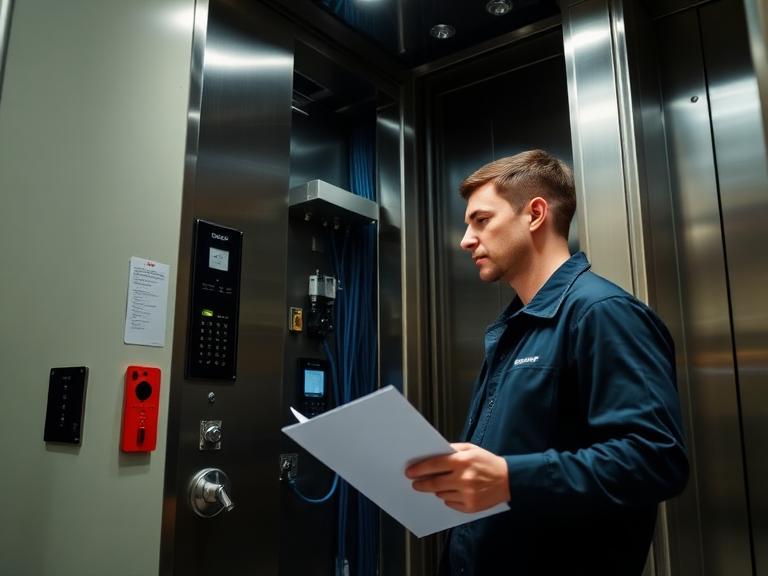
Elevator safety compliance is the rigorous technical, administrative, and physical auditing process that ensures an elevator meets all statutory safety codes before and during its operational lifecycle.
┌─────────────────────────────────────────────────────────────────────────┐
│                 ELEVATOR SAFETY COMPLIANCE ARCHITECTURE                 │
├───────────────────────────────────┬─────────────────────────────────────┤
│      STATUTORY / ADMINISTRATIVE   │        PHYSICAL / ENGINEERING       │
├───────────────────────────────────┼─────────────────────────────────────┤
│ • CEIG Form-A Erection Permission │ • Electromechanical Main Brakes     │
│ • CEIG Form-B Operational License │ • Mechanical Overspeed Governor     │
│ • Annual Inspection Fitness Log   │ • Automatic Rescue Device (ARD)     │
│ • Third-Party IS 17900 Audit Cert │ • Full-Height Infrared Light Curtain│
│ • Valid Comprehensive AMC Record │ • Door Interlock Safety Chain Loops │
└───────────────────────────────────┴─────────────────────────────────────┘
Compliance requires more than keeping up with routine maintenance visits. It demands verified physical testing of fail-safe mechanisms—such as dynamic load brake holds, overspeed governor trips, emergency power simulations, door interlock integrity checks, and structural pit buffer inspections.
Core Regulatory Pillars in Telangana
- Statutory Authorization: Obtaining mandatory government Form-A (Erection Approval) and Form-B (License to Run) permits from the Telangana Electrical Inspectorate.
- Standard Alignment: Adhering to Bureau of Indian Standards specifications (IS 14665 for traction lifts and IS 17900:2022 for updated safety rules).
- Emergency Redundancy: Installing mandatory battery-backed Automatic Rescue Devices (ARD) to prevent passenger entrapment during power grid failures.
- Third-Party Auditing: Conducting comprehensive independent safety inspections to verify that contracted Annual Maintenance Contract (AMC) vendors do not bypass safety circuits.
2. Telangana Lift Act & CEIG Regulatory Framework
In Telangana, vertical transportation systems are governed by strict statutory regulations enforced by the Chief Electrical Inspectorate to Government (CEIG) under the Telangana Lifts, Escalators, and Passenger Conveyors Act.
                 TELANGANA CEIG STATUTORY PERMIT WORKFLOW
                                       │
       ┌───────────────────────────────┼───────────────────────────────┐
       ▼                               ▼                               ▼
FORM-A PERMISSION TO ERECT     FORM-B OPERATIONAL LICENSE      ANNUAL RENEWAL & AUDIT
──────────────────────────     ──────────────────────────      ──────────────────────
Blueprint approval, civil      Granted following physical site Annual / triennial safety
shaft stability clearance, and inspection, load testing, and   audit logs required to maintain
electrical layout sanction.    governor trip verification.     valid legal operational status.
Key Legal Requirements & Liabilities
- Form-A (Permission to Erect): Developers and builders must submit technical blueprints, civil shaft stability certificates, and electrical distribution plans to the CEIG before elevator installation begins.
- Form-B (License to Run): Issued only after a state government lift inspector physically verifies the installation, performs trial runs under full-rated payload, and tests overspeed governor safety jaws.
- Building Owner & RWA Liability: Under state law, primary legal responsibility for accidents resulting from lapsed licenses or neglected maintenance rests directly with the property owner, commercial facility director, or Residents’ Welfare Association (RWA) board.
- Municipal Occupancy Certificate (OC) Linkage: The Greater Hyderabad Municipal Corporation (GHMC) and Hyderabad Metropolitan Development Authority (HMDA) require active CEIG Form-B operational licenses before issuing building Occupancy Certificates.
- Insurance Validity Mandatory Clause: Commercial and residential property insurance policies across Hyderabad state that insurance claims for elevator incidents will be rejected if the lift was operating with an expired CEIG license.
3. Key Indian Safety Standards: IS 14665 & IS 17900:2022
Certified safety compliance requires evaluating installations against updated Bureau of Indian Standards guidelines:
┌─────────────────────────────────────────────────────────────────────────┐
│                    INDIAN ELEVATOR SAFETY STANDARDS                     │
├───────────────────────────────────┬─────────────────────────────────────┤
│ IS 14665 (TRACTION LIFT CODE)     │ IS 17900:2022 (UPDATED SAFETY RULES)│
├───────────────────────────────────┼─────────────────────────────────────┤
│ • Mechanical Overspeed Governors  │ • Unintended Car Movement (UCMP)    │
│ • Electromechanical Main Brakes   │ • Enhanced Pendulum Door Impact Test│
│ • Full-Height Door Light Curtains │ • Fire Classification of Materials  │
│ • Automatic Rescue Device (ARD)   │ • Expanded Pit & Car-Top Refuge Space│
│ • Overload Sensing & Interlocks   │ • Enhanced Shaft & Pit Illumination │
└───────────────────────────────────┴─────────────────────────────────────┘
Essential Mandates Under IS 17900:2022
- Unintended Car Movement Protection (UCMP): Elevators must incorporate dual-circuit braking mechanisms that automatically stop the elevator car if it moves away from a floor landing while landing doors are unlocked.
- Door Impact Resistance: Landing and car doors must withstand rigorous pendulum impact tests to prevent doors from popping off their tracks if bumped by passengers or moving carts.
- Enhanced Pit & Car-Top Refuge Spaces: Guarantees minimum safety clearances inside the hoistway pit and on top of the car roof to protect maintenance engineers during servicing.
4. Comprehensive 8-Zone Safety Compliance Checklist
A complete third-party safety compliance audit evaluates eight distinct engineering zones:
                               8-ZONE AUDIT ARCHITECTURE
                                           │
    ┌───────────────┬───────────────┬──────┴────────┬───────────────┬───────────────┐
    ▼               ▼               ▼               ▼               ▼               ▼
MACHINE ROOM    CAR TOP & ROOF   HOISTWAY PIT   LANDING DOORS   CABIN INTERIOR  EMERGENCY ARD
────────────    ──────────────   ────────────   ─────────────   ──────────────  ─────────────
• Drive Motor   • Top Stop Box   • Buffers      • Interlocks    • Light Curtain • Battery Bank
• Main Brakes   • OSG Trigger    • Tension Wheel• Mechanical     • COP Displays  • Auto-Leveling
• Control Panel • Inspection Mode• Pit Lighting  Landing Locks  • Intercom Call  Grid Simulation
Zone 1: Machine Room Machinery & Braking Systems
- Electromechanical Main Brakes: Measure brake lining thickness, plunger air gap clearance, and verify dual-coil electrical independence. Perform dynamic brake hold tests at $125\%$ payload.
- Mechanical Overspeed Governor (OSG): Verify governor rope tension, flyweight calibration, and conduct physical trip speed testing.
- Microprocessor Control Panel: Inspect contactors for arc pitting, verify flame-retardant wiring, test grounding continuity, and check terminal screw tightness.
Zone 2: Elevator Car Top & Hoistway Shaft
- Car-Top Inspection Box: Verify functionality of the Emergency Stop switch, Inspection/Normal selector switch, and Up/Down movement buttons.
- Progressive Safety Gear Linkage: Test the mechanical rod assembly connecting the governor rope to the car safety jaws.
- Guide Rail Brackets & Alignment: Check guide rail bracket anchor bolts, guide shoe gib wear, and auto-oiler reservoir levels.
Zone 3: Hoistway Pit & Buffer Systems
- Oil & Spring Buffers: Verify oil levels in hydraulic buffers and check return switches. Ensure spring buffers are free of rust or structural damage.
- Pit Stop Switch & Illumination: Confirm accessibility of the pit emergency stop button and verify minimum 100 Lux lighting illumination.
- Pit Seepage & Hygiene Check: Confirm pit is completely dry and free of monsoon water, oil pooling, or trash accumulation.
┌─────────────────────────────────────────────────────────────────────────┐
│                    HOISTWAY PIT SAFETY REQUIREMENTS                     │
├─────────────────────────────────────────────────────────────────────────┤
│ ✔ Minimum 100 Lux Permanent Pit Lighting Installed                   │
│ ✔ Dual Emergency Pit Stop Switches Fully Operational                   │
│ ✔ Hydraulic / Spring Buffers Inspected & Free of Leakage             │
│ ✔ Tension Pulley Safety Switch Trips Perfectly                         │
│ ✔ Pit Free of Standing Water, Oil, and Trash Debris                    │
└─────────────────────────────────────────────────────────────────────────┘
Zone 4: Landing Entrances & Door Interlocks
- Electromechanical Door Interlocks: Ensure car cannot move if any landing door is unlatched by even $2\text{ mm}$.
- Infrared Light Curtains: Confirm full-height multi-beam infrared arrays across the door entrance instantly reverse doors upon obstruction.
Zone 5: Cabin Interior & User Interfaces
- Floor Leveling Accuracy: Measure stopping precision at every floor under empty, half, and full load conditions (target: $\pm 2\text{ mm}$).
- Overload Sensor Interlock: Calibrate overload sensor; verify that car parks with doors open and alarm sounds when weight capacity is exceeded.
- Emergency Alarm & Intercom: Test two-way communication between cabin interior, security desk, and machine room.
Zone 6: Automatic Rescue Device (ARD) System
- Grid Cut Simulation: Disconnect main 3-phase power during car travel to test automatic rescue response.
- Battery Bank Load Test: Measure voltage drop under load across all ARD batteries to confirm sufficient power reserve.
                         AUTOMATIC RESCUE DEVICE (ARD) AUDIT
                                          │
       ┌──────────────────────────────────┼──────────────────────────────────┐
       ▼                                  ▼                                  ▼
GRID CUT SIMULATION               BATTERY LOAD TEST               SMOOTH FLOOR LEVELING
───────────────────               ─────────────────               ─────────────────────
Cut primary power during          Measure individual battery      Car moves to nearest floor,
travel to trigger ARD.        voltage under load.           opens doors, and safely
                                                                  evacuates passengers.
Zone 7: Steel Suspension Ropes & Counterweight
- Wire Rope Inspection: Perform visual and Non-Destructive Testing (NDT) checks for wire breakage, crown wear, rust, or diameter reduction ($>6\%$).
- Equal Rope Tensioning: Measure individual rope tensions using a digital gauge to ensure uniform load distribution.
Zone 8: Fire Safety & Emergency Controls
- Fireman’s Emergency Switch: Confirm that activating the fireman key grounds the elevator directly to the primary landing floor and disables normal hall calls.
5. Non-Destructive Testing (NDT) & Diagnostic Equipment
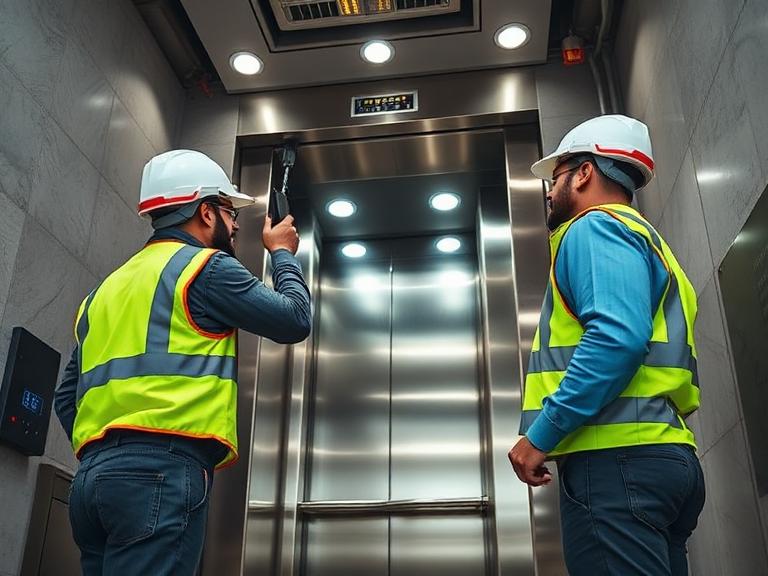
Certified compliance audits utilize advanced diagnostic instruments to evaluate equipment condition objectively:
┌─────────────────────────────────────────────────────────────────────────┐
│               ADVANCED DIAGNOSTIC EQUIPMENT USED IN AUDITS              │
├───────────────────────────────┬─────────────────────────────────────────┤
│ DIAGNOSTIC TOOL               │ PURPOSE & MEASUREMENT TARGET            │
├───────────────────────────────┼─────────────────────────────────────────┤
│ Electromagnetic Rope Tester   │ Detects internal wire rope breaks & core│
│ Digital Tachometer            │ Measures contract speed, governor trip  │
│ ISO 18738 Accelerometer       │ Quantifies 3-axis vibration & jerk rates│
│ Thermal Infrared Camera       │ Scans control panels for hot contacts   │
│ Insulation Resistance Tester  │ Measures motor winding insulation (>5MΩ)│
│ Digital Rope Tension Meter    │ Verifies equal tension across traction  │
└───────────────────────────────┴─────────────────────────────────────────┘
- Electromagnetic Wire Rope Tester (NDT): Detects internal strand breaks, core fatigue, and cross-sectional area loss without damaging the rope.
- Thermal Infrared Imaging: Scans control panels, contactors, VFD inverter terminals, and motor windings to identify loose contacts and electrical overheating risks.
- ISO 18738 Ride Quality Accelerometer: Quantifies 3-axis acceleration curves ($Z, Y, X$), acoustic noise levels ($dB$), and jerk rates during travel.
6. Step-by-Step Compliance Processing & Certification Workflow
Achieving full CEIG compliance follows an established technical and administrative process:
┌───────────────────────────────────────────────────────────────────────────┐
│                   COMPLIANCE EXECUTION WORKFLOW TIMELINE                  │
├───────────────────────────────────────────────────────────────────────────┤
│ STEP 1: Pre-Inspection Compliance Audit & Documentation Review (Days 1–2)│
│ STEP 2: Defect Rectification & AMC Vendor Coordination (Days 3–7)         │
│ STEP 3: Online CEIG Application Submission via Digital Portal (Day 8)     │
│ STEP 4: Site Field Inspection by Government Lift Inspector (Days 9–12)    │
│ STEP 5: Dynamic Load Testing, ARD Verification & Safety Loop Clearance   │
│ STEP 6: Grant & Display of Official CEIG Form-B Fitness License (Day 15)  │
└───────────────────────────────────────────────────────────────────────────┘
Phase 1: Pre-Inspection Audit & Rectification
Accredited safety engineers conduct an exhaustive pre-audit using the CEIG inspection framework. Any identified non-compliances (such as discharged ARD batteries or improper door interlock clearances) are rectified immediately by the AMC vendor.
Phase 2: CEIG Digital Portal Application
Documentation—including Form-A erection approvals, civil stability certificates, wiring diagrams, and valid AMC contracts—is submitted through the state’s digital inspectorate portal.
Phase 3: Field Inspection & Dynamic Load Testing
A government electrical inspector visits the site to execute trial runs under full-rated payload, manually trip overspeed governors, test ARD power failure response, and verify electrical grounding.
Phase 4: License Grant & Physical Display
Upon successful inspection, the official CEIG Form-B Operational License is issued. A metallic registration plate displaying the unique registration number and fitness validity must be permanently mounted inside the car operating panel or near the machine room entrance.
7. Cost Matrix for Elevator Compliance Services in Hyderabad
Compliance service pricing varies based on building height, capacity, speed, and required diagnostic depth.
                     COMPLIANCE COST ALLOCATION
    ┌──────────────────────────────────────────────────────────────┐
    │  Third-Party Engineering Audit & Stress Testing [35% - 40%]  │
    │  CEIG Statutory Licensing Processing & Forms   [25% - 30%]   │
    │  Safety Hardware Retrofitting (ARD, Lights)   [25% - 30%]   │
    │  Documentation, Certificates & Final Plate     [10% - 15%]   │
    └──────────────────────────────────────────────────────────────┘
Estimated Elevator Safety Compliance Pricing Matrix
| Service Package | Target Property Profile | Scope of Work & Deliverables | Estimated Cost per Lift (INR)* |
| Pre-Inspection Audit | Low-Rise Apartments (G+4) | Physical 8-zone safety check, ARD test, interlocks, pit check, audit report | ₹5,000 – ₹7,500 |
| CEIG Licensing Package | Gated Communities / Offices | Complete Form-A / Form-B processing, documentation, inspector liaison | ₹12,500 – ₹18,500 |
| Third-Party IS 17900 Audit | High-Rise IT Towers | NDT wire rope testing, ISO ride quality, thermal imaging, UCMP verification | ₹18,500 – ₹35,000 |
| Complete ARD Retrofit | Non-Compliant Legacy Lifts | Supply & installation of battery-backed ARD unit, light curtains, OSG upgrade | ₹35,000 – ₹55,000+ |
*Note: Official government statutory inspection fees charged by the Electrical Inspectorate are billed separately as actuals.
8. Sector-Specific Solutions Across Hyderabad Micro-Markets
                      SECTOR-SPECIFIC SAFETY COMPLIANCE
                                      │
    ┌─────────────────────────────────┼─────────────────────────────────┐
    ▼                                 ▼                                 ▼
 IT PARKS & CORPORATE             GATED RESIDENTIAL               HOSPITALS & HEALTHCARE
(HITEC City / Financial Dist.)  (Kukatpally / Kondapur / Miyapur) (Banjara Hills / Secunderabad)
 ─────────────────────────────   ────────────────────────────────  ───────────────────────────────
 • High-Speed Governor Audits    • ARD Power Outage Rescue         • Precision Stretcher Leveling
 • UCMP System Verification      • Child & Elderly Light Curtains  • Fireman Priority Override
 • Thermal Control Panel Scans   • Pit Water Seepage Checks        • Hygienic Seal Integrity
1. IT Parks & Corporate Towers (HITEC City, Gachibowli, Financial District, Madhapur)
- Focus on high-speed overspeed governor tripping, brake holding torque under peak traffic, thermal imaging of VFD drives, and UCMP system compliance.
2. High-Rise Gated Communities (Kukatpally, Kondapur, Miyapur, Kompally)
- Focus on battery-backed ARD rescue checks, infrared light curtain door safety for children and elderly residents, and monsoon pit water seepage prevention.
3. Healthcare Facilities & Hospitals (Banjara Hills, Jubilee Hills, Secunderabad)
- Focus on floor leveling accuracy ($\pm 2\text{ mm}$) to prevent jarring patient stretchers, fireman switch priority bypass, and emergency generator transition response.
9. How to Select a Safety Compliance Partner in Hyderabad
When selecting an elevator safety compliance consultancy or third-party auditor in Telangana, verify the following credentials:
- Third-Party Independence: The auditing firm must be independent from your current AMC maintenance vendor to eliminate conflicts of interest.
- Certified Engineering Personnel: Auditors must hold degree/diploma credentials in Mechanical/Electrical Engineering with specialized training in elevator safety standards (IS 14665 / IS 17900).
- Advanced Diagnostic Capability: The auditing team must carry specialized instruments, including NDT rope testers, thermal imaging cameras, digital tachometers, and ride quality accelerometers.
- CEIG Liaison Expertise: Demonstrated track record navigating the Telangana Electrical Inspectorate digital portal and inspector field clearance processes.
Frequently Asked Questions (FAQs)
Q1: What is elevator safety compliance in Hyderabad?
Answer: Elevator safety compliance in Hyderabad refers to adhering strictly to statutory regulations defined under the Telangana Lifts, Escalators, and Passenger Conveyors Act, Chief Electrical Inspectorate to Government (CEIG) mandates, National Building Code (NBC 2016), and Bureau of Indian Standards codes (IS 14665 and IS 17900:2022). Compliance requires securing valid operating licenses (Form-B), conducting mandatory annual safety audits, and installing certified fail-safe mechanisms like Automatic Rescue Devices (ARD), double-safety brakes, and infrared door light curtains.
Q2: Is elevator safety compliance legally mandatory in Telangana?
Answer: Yes. Under state law, operating a passenger or freight elevator without a valid license issued by the Chief Electrical Inspectorate to Government (CEIG) is a punishable offense. Non-compliant elevator operations can result in immediate sealing of the hoistway, heavy financial penalties, GHMC occupancy certificate cancellation, and direct criminal and civil liability for building owners or Residents’ Welfare Association (RWA) board members in the event of an accident.
Q3: What is the difference between Form-A and Form-B elevator permits in Hyderabad?
Answer: Form-A is the initial “Permission to Erect” granted by the CEIG before elevator installation begins, requiring approval of civil hoistway drawings, motor specifications, and structural stability plans. Form-B is the official “License to Run” granted after physical installation is complete and a government lift inspector has conducted physical load tests, brake holding checks, and safety circuit evaluations.
Q4: How often must elevator safety compliance inspections be conducted?
Answer: Statutory CEIG operational licenses require periodic annual or triennial renewals depending on building categorization. However, third-party safety compliance audits should be conducted annually for residential gated communities and semi-annually or quarterly for high-density IT parks, commercial towers, and healthcare facilities across Hyderabad.
Q5: What safety devices are checked during a CEIG compliance audit?
Answer: Inspectors test the Mechanical Overspeed Governor (OSG), Progressive Safety Gear jaws, Electromechanical Main Brakes, Automatic Rescue Device (ARD), Infrared Full-Height Door Light Curtains, Electromechanical Door Interlock Switches, Overload Sensors, Limit Switches, Emergency Intercoms, and Pit Oil/Spring Buffers.
Q6: Why is an Automatic Rescue Device (ARD) mandatory for compliance in Hyderabad?
Answer: The Telangana Lift Act mandates ARDs on all passenger elevators to prevent passenger entrapment during power grid cuts or phase failures. An ARD is a battery-backed backup system that automatically drives the elevator car to the nearest floor landing, opens the doors, and evacuates passengers safely within 30 seconds of a power outage.
Q7: How much does elevator safety compliance processing cost in Hyderabad?
Answer: Professional pre-inspection audits typically range from ₹5,000 to ₹8,500 per lift. Full CEIG Form-A and Form-B licensing documentation and inspection management packages range from ₹12,500 to ₹22,000. Third-party comprehensive IS 17900 audits for commercial towers cost between ₹15,000 and ₹35,000 per elevator shaft.
Q8: Does building insurance cover elevator accidents if the CEIG license is expired?
Answer: No. Commercial and residential property insurance policies in Hyderabad explicitly state that claims arising from elevator accidents will be summarily rejected if the elevator was operating with an expired CEIG license or lacked certified maintenance logs.
Q9: Who is held legally responsible if an elevator accident occurs in a residential apartment?
Answer: Under the Telangana Lifts Act, primary legal liability rests squarely with the building owner, management firm, or office bearers of the Residents’ Welfare Association (RWA). They are legally responsible for ensuring active licensing, certified maintenance contracts, and immediate rectification of identified safety defects.
Q10: What is Unintended Car Movement Protection (UCMP) under IS 17900:2022?
Answer: UCMP is a fail-safe mechanism mandated under updated IS 17900 standards that detects and stops unauthorized movement of the elevator car away from a floor landing when the landing doors are unlocked, preventing passenger shearing or crushing accidents.
Q11: Can an elevator fail its CEIG compliance inspection?
Answer: Yes. Common reasons for failing a CEIG inspection include a dysfunctional ARD battery system, non-operational door interlock switches, lack of multi-beam light curtains, worn traction ropes, water accumulation in the pit, and failure to perform manual overspeed governor trips.
Q12: What steps are required if an elevator fails a safety inspection?
Answer: If defects are identified, the inspector issues a compliance defect notice. The elevator management must immediately instruct their AMC engineering partner to rectify the non-compliances, perform a re-audit, and submit a compliance verification report to obtain license clearance.
Q13: Are home lifts and private villa elevators required to follow safety compliance rules?
Answer: Yes. All vertical transportation installations, including private residential villa lifts and home elevators in Jubilee Hills or Banjara Hills, must adhere to BIS safety standards and register with statutory authorities to ensure structural and operational safety.
Q14: How does GHMC link building Occupancy Certificates to lift compliance?
Answer: The Greater Hyderabad Municipal Corporation (GHMC) and Hyderabad Metropolitan Development Authority (HMDA) mandate proof of successful elevator commissioning and active CEIG Form-B licenses before issuing or renewing commercial and residential building Occupancy Certificates (OC).
Q15: Which zones in Hyderabad do you cover for elevator safety compliance services?
Answer: Services cover all commercial and residential sectors across Greater Hyderabad and Secunderabad, including HITEC City, Gachibowli, Madhapur, Kondapur, Jubilee Hills, Banjara Hills, Kukatpally, Miyapur, Kompally, Begumpet, Secunderabad, Uppal, LB Nagar, and Financial District.
Conclusion: Secure Your Certified Elevator Safety Compliance Today
Operating an uncertified or non-compliant elevator exposes property owners, RWAs, and facility directors to legal liabilities, severe financial penalties, and passenger safety risks under Telangana state laws. Investing in elevator safety compliance in Hyderabad guarantees complete CEIG licensing, adherence to IS 17900 safety standards, and verified ARD protection—ensuring safe, reliable, and legal vertical transportation across every floor.