
Table of Contents
Causes of Anal Fissure | Mechanical, Anatomical & Systemic Etiologies
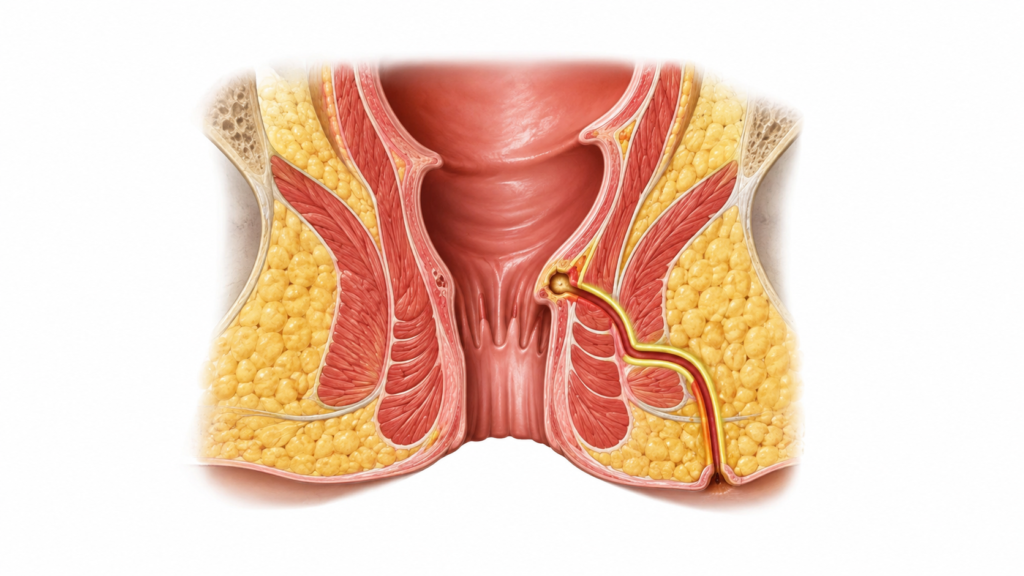
An anal fissure is a longitudinal mucosal split in the anoderm—the lining of the distal anal canal extending from the dentate line to the anal verge. Understanding the causes of anal fissure requires examining a combination of primary mechanical trauma, internal anal sphincter (IAS) dynamics, microvascular vascularity, and underlying systemic health conditions.
While mechanical injury is the initial triggering event, anatomical vulnerability and sphincter spasm are the core drivers that prevent healing and transition an acute tear into a chronic ulcer.
Primary Mechanisms Triggering Anal Fissures
Primary anal fissures account for over 90% of clinical cases and result from local mechanical injury coupled with hypertonia of the internal anal sphincter.
+-----------------------------------------------------------------------------------+
|                        PRIMARY ETIOLOGICAL FACTORS & MECHANISMS                   |
|                                                                                   |
|  1. MECHANICAL ABRASION    : Passage of hard, dry, scybalous stool.               |
|  2. CHEMICAL IRRITATION    : Chronic liquid diarrhea rich in digestive enzymes.   |
|  3. OBSTETRIC TRAUMA       : Perineal stretching during prolonged vaginal birth.   |
|  4. RECEPTIVE TRAUMA       : Mechanical stretching from foreign objects or sex.     |
+-----------------------------------------------------------------------------------+
1. Mechanical Straining & Hard Stools (Constipation)
The most common trigger is the passage of large, hard, or dry fecal masses (scybala). Constipation forces excessive straining, which elevates intra-anal pressures during defecation. When hard stool passes through the closed anal canal, it over-stretches the anoderm, exceeding its elastic limit and creating a longitudinal tear.
2. Chronic Diarrhea & Chemical Erosion
Frequent, watery bowel movements are a frequently overlooked cause of anal fissures. Rapid, repeated evacuation causes:
- Mechanical friction from multiple bowel movements in a short window.
- Chemical irritation from unabsorbed bile salts and digestive enzymes in liquid stool that erode the delicate mucosal epithelium.
3. Obstetric & Childbirth Trauma
During the second stage of labor, the fetal head exerts intense pressure on the pelvic floor and perineum. Severe stretching, tearing, or episiotomy extension during vaginal delivery can lacerate the anterior anal canal, making anterior anal fissures significantly more common in postpartum women.
4. Direct Physical Trauma or Insertion
Over-stretching of the anoderm from receptive anal intercourse without adequate lubrication, insertion of foreign objects, or vigorous wiping with rough toilet paper can directly tear the anoderm.
Sphincter Dynamics & Microvascular Anatomical Factors
Mechanical trauma initiates the tear, but specific anatomical features explain why fissures occur where they do and why they often fail to heal naturally.
                           POSTERIOR MIDLINE VULNERABILITY

                  +----------------------------------------------+
                  |  Anomalous Microvascular Perfusion           |
                  |  (Relative Ischemia at Posterior Midline)    |
                  +----------------------+-----------------------+
                                         |
                                         v
                  +----------------------------------------------+
                  |  Tear Occurs at 6 o'Clock Position            |
                  +----------------------+-----------------------+
                                         |
                                         v
                  +----------------------------------------------+
                  |  Internal Anal Sphincter (IAS) Spasm         |
                  |  (Elevated Resting Anal Pressure > 90 mmHg)  |
                  +----------------------+-----------------------+
                                         |
                                         v
                  +----------------------------------------------+
                  |  Perfusion Cutoff -> Non-Healing Ulcer       |
                  +----------------------------------------------+
The Role of Internal Anal Sphincter (IAS) Hypertonia
The internal anal sphincter is an involuntary smooth muscle responsible for ~70–80% of resting anal tone. In patients who develop chronic fissures, resting sphincter pressure is pathologically elevated (often exceeding $90\text{ mmHg}$, compared to normal levels of $40\text{–}70\text{ mmHg}$).
When a tear occurs, sensory nerve pain triggers a continuous, involuntary contraction (spasm) of the IAS. This spasm compresses the small arteriolar branches passing through the muscle, severely compromising blood supply to the edges of the tear (microvascular ischemia).
Anatomical Weakness: Why Fissures Occur at 6 o’Clock
- Posterior Midline (90% of cases): Angiographic studies demonstrate that blood supply to the posterior anal canal (the 6 o’clock position) is naturally inferior to other segments. The superficial external anal sphincter muscle fibers also form a V-shaped gap posteriorly, providing weaker structural support to the overlying anoderm.
- Anterior Midline (8% to 10% of cases): Anterior fissures (12 o’clock position) occur less commonly and are seen predominantly in females following obstetric trauma or pelvic floor weakness.
Secondary & Systemic Causes of Anal Fissure
When an anal fissure presents in atypical locations (such as the lateral 3 o’clock or 9 o’clock positions), is multiple, or is painless, secondary systemic pathologies must be evaluated.
+---------------------------------------------------------------------------------------+
|                 PRIMARY VS. SECONDARY ANAL FISSURES COMPARISON                        |
+----------------------+-----------------------------+----------------------------------+
| Feature              | Primary Anal Fissure        | Secondary Anal Fissure           |
+----------------------+-----------------------------+----------------------------------+
| **Anatomical Site**  | Midline (Posterior 90%,     | Atypical / Lateral (3 & 9 o'clock|
|                      | Anterior 10%)               | positions) or Multiple           |
| **Primary Cause**    | Constipation, hard stool,   | Inflammatory Bowel Disease,      |
|                      | high sphincter tone         | Infections, Malignancy           |
| **Pain Level**       | Exquisite, severe pain      | Variable; often mild or painless |
| **Sphincter Tone**   | Hypertonic (tight/spastic)  | Normal or Hypotonic (lax)        |
| **Base Appearance**  | Clean tear or muscle fibers | Broad-based, deep, granulomatous |
+----------------------+-----------------------------+----------------------------------+
Systemic Conditions Linked to Secondary Fissures:
- Crohn’s Disease & IBD: Transmural inflammation in Crohn’s disease causes deep, indolent, lateral ulcers that often present with surrounding skin tags, abscesses, or fistulas.
- Infectious Diseases:
- Tuberculosis (TB): Gastrointestinal TB can manifest as non-healing granulomatous perianal ulcers.
- Syphilis (Primary Chancre): Can present as an atypical, painless anal ulcer.
- HIV / Immunosuppression: Opportunistic viral infections (Cytomegalovirus, Herpes Simplex) or reduced immune cell counts can cause refractory anal ulcerations.
- Anal Malignancy: Squamous cell carcinoma, adenocarcinoma, or leukemic infiltrates can mimic non-healing chronic fissures.
- Iatrogenic / Surgical Causes: Lacerations secondary to rigid anoscopy, endosonography probes, or previous hemorrhoid surgery scar tissue (ectropion).
Behavioral & Lifestyle Risk Factors
Several daily lifestyle factors increase the likelihood of developing an anal fissure by altering stool consistency or rectal dynamics:
1.1. CHRONIC LOW-FIBER DIET:Stool Hardening.
Inadequate dietary fiber (less than 20–25 grams/day) leads to small, dense, scybalous stools that require high force to pass, causing mechanical abrasion of the anoderm.
2.2. INSUFFICIENT FLUID INTAKE:Dehydration.
Low water intake causes the colon to extract excess water from stool, rendering the fecal mass hard and abrasive.
3.3. DELAYING DEFECATION (STOOL WITHHOLDING):Dyssynergic Defecation.
Ignoring the urge to pass stool causes fecal retention in the rectum, where continuous water absorption makes the stool progressively larger and harder.
4.4. PROLONGED SITTING & INACTIVITY:Sedentary Lifestyle.
Lack of physical activity slows intestinal transit time, worsening chronic constipation and increasing the risk of hard stools.
Frequently Asked Questions (10 Detailed FAQs)
Q1: What is the single most common cause of an anal fissure?
A: The most common cause is mechanical injury to the anal canal during a bowel movement, usually from passing hard, dry, or large stools during episodes of constipation.
Q2: Can chronic diarrhea cause an anal fissure?
A: Yes. Frequent liquid bowel movements contain unabsorbed digestive enzymes and acidic bile salts that erode mucosal tissue, while rapid evacuation causes mechanical stress and micro-tears.
Q3: Why do over 90% of primary fissures occur at the posterior midline?
A: The posterior midline (6 o’clock position) has poorer baseline blood flow and weaker muscular support from the external anal sphincter compared to other parts of the anal canal.
Q4: How does sphincter muscle spasm turn a simple tear into a chronic fissure?
A: Pain from a tear causes involuntary spasms (hypertonia) of the internal anal sphincter. This spasm squeezes blood vessels passing through the muscle, creating local ischemia (lack of blood flow) that prevents the tissue from healing naturally.
Q5: Why are anterior anal fissures more common in women?
A: Anterior anal fissures (12 o’clock position) are closely linked to childbirth trauma. Intense perineal stretching or tearing during vaginal delivery weakens the anterior anal wall.
Q6: What medical conditions cause secondary anal fissures?
A: Secondary fissures are caused by systemic conditions including Crohn’s disease, Ulcerative Colitis, Tuberculosis, HIV, Syphilis, or anal cancer.
Q7: Can anal intercourse cause an anal fissure?
A: Yes. Receptive anal intercourse without sufficient lubrication or inadequate relaxation of the sphincter muscle can over-stretch the anoderm, resulting in mucosal lacerations.
Q8: Does a low-fiber diet directly cause anal fissures?
A: A low-fiber diet leads to small, hard stools that require excessive straining to pass. The mechanical scraping of hard stool against the delicate anal mucosa is a leading indirect cause of fissures.
Q9: What is the difference between a primary and a secondary anal fissure?
A: Primary fissures are caused by mechanical injury and high sphincter pressure, appearing at the posterior or anterior midline. Secondary fissures stem from systemic diseases (like Crohn’s), are often painless or laterally located, and occur with normal or low sphincter tone.
Q10: When should an anal fissure cause concern for underlying disease?
A: Fissures located off the midline (at 3 or 9 o’clock positions), multiple fissures, painless ulcers, or those accompanied by chronic diarrhea, weight loss, fever, or pus discharge should be promptly evaluated for systemic conditions like Inflammatory Bowel Disease.

Summary: Key Takeaways on Anal Fissure Causes
While mechanical trauma from hard stools or severe diarrhea initiates an anal fissure, it is internal sphincter hypertonia and poor posterior tissue perfusion that perpetuate the wound. Differentiating between primary mechanical causes and secondary systemic diseases (such as Crohn’s or infections) ensures accurate diagnosis and targeted treatment.